4.3 KiB
4.3 KiB
Related:
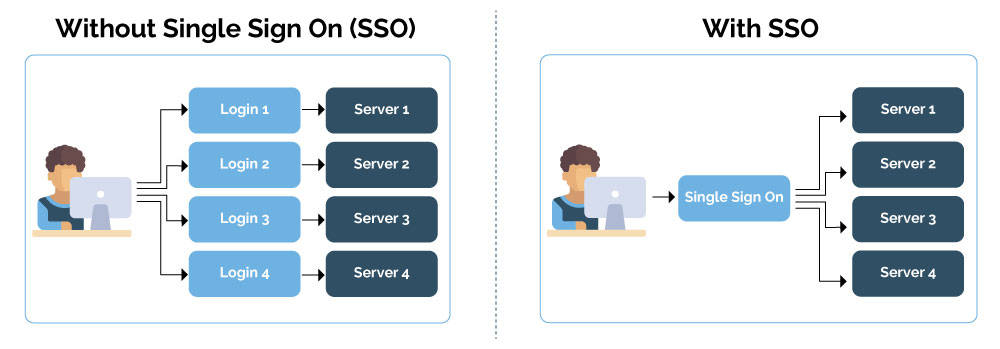
Single Sign-On or SSO is an authentication process that allows consumers to log in to multiple independent applications with a single set of credentials. With SSO, users can access a suite of applications via one single login, irrespective of the platform, technology, or domain used.
On a similar note, it is also a challenge for both users and IT administrators to secure thousands of accounts and related user data.
For both users and IT administrators, securely handling thousands of accounts and related user data is challenging. Enterprises use single sign-on as a single strategy to improve IT security, improve user experience, and cut IT cost in one go.
Advantages of SSO
- Reduces password fatigue. Remembering one password instead of many makes users’ lives easier. As a tangential benefit, it gives users greater incentive to come up with strong passwords.
- Simplifies username and password management. When changes of personnel take place, SSO reduces both IT effort and opportunities for mistakes. Employees leaving the organization relinquish their login privileges.
- Improves identity protection. With SSO, companies can strengthen identity security with techniques such as two-factor authentication (2FA) and multifactor authentication (MFA).
- Increases speed where it is most needed. In settings such as hospitals, defense industries, and emergency services, where large numbers of people and departments demand rapid and unfettered access to the same applications, SSO is especially helpful. In such cases, preventing errors and malware intrusion can be the difference between life and death.
- Relieves help desk workloads. Fewer users calling for help with lost passwords saves money and improves security.
- Reduces security risks for your customers, vendors, and partner entities. Connections between allied companies always present vulnerabilities, which SSO can reduce.
- Effective SSO solutions are available. There is no reason for any organization to create its own system or to develop deep SSO expertise. RenovoData’s consultants understand available offerings and can help identify the best choices for your company.
SSO’s challenges
- Extra-strong passwords must be enforced. If an SSO account is cracked, others under the same authentication can also be endangered. -> combine with Phishing-Resistant MFA
- When SSO is down, access to all connected sites is stopped. This is a big reason to exercise great care in choosing an SSO system. It must be exceptionally reliable and plans should be in place for dealing with breakdowns.
- What’s more, when your identity provider goes down, your SSO does too. The provider’s vulnerability to any kind of interruption becomes your vulnerability as well, and it is probably beyond your control. Once again, the choice of vendors is critical.
- If a hacker breaches your identity provider user account, all your linked systems could be open to attack. This can be a classic single point of failure and should be headed off in the planning process. On the plus side, high-quality identity providers have top-notch security.
- SSO can take longer than expected to set up. Each environment is different, so added steps in implementation can crop up. One example is the task linking the identity provider to the service provider.
- SSO is risky for multi-user computers. What happens when one user is logged in and another needs to use the machine?
- Reduced sign-on (RSO) may be needed to accommodate different levels of access. With RSO, additional authentication servers may be required.
- SSO using social networking services can create conflict. This can be the case with workplaces that block social media sites and government connections where censorship is involved.
- Some SSO-linked sites may give their user data to third-party entities. This is an area requiring careful attention.